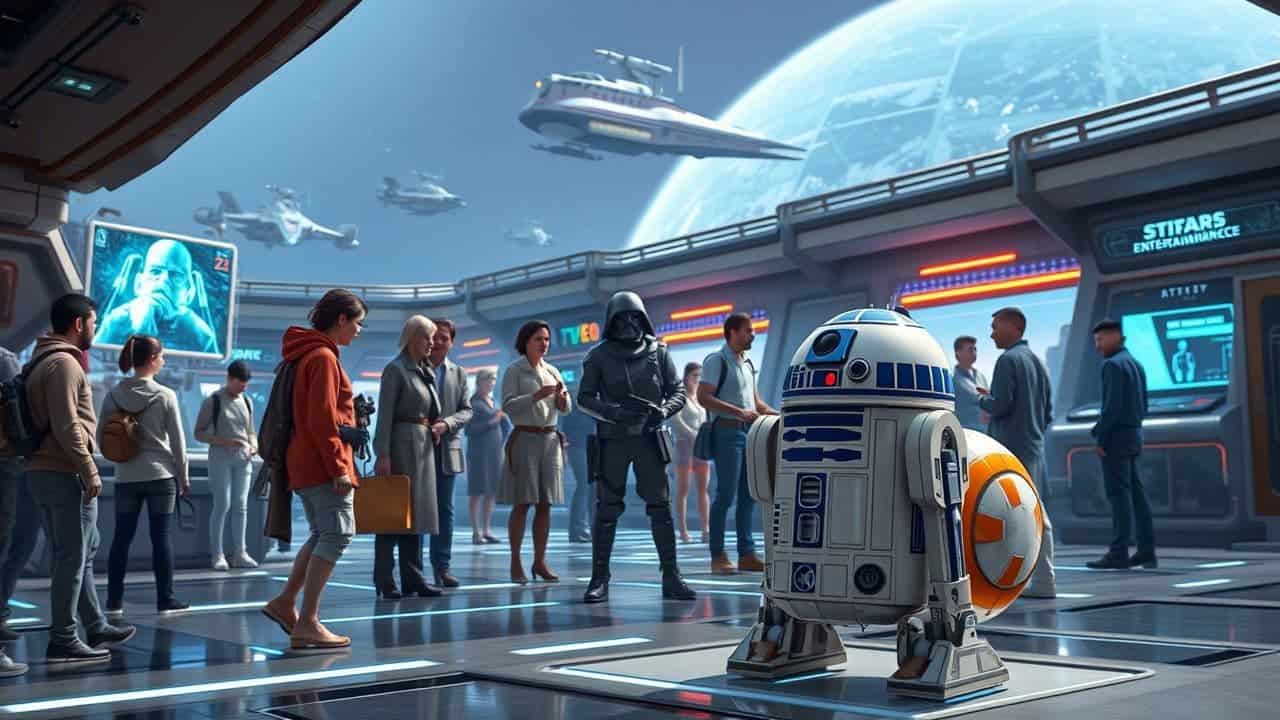
Artificial Intelligence and the Galaxy Far, Far Away: The Role of AI in the Star Wars Universe and Digital Entertainment
From hyperdrives to humanoid droids, Star Wars has long inspired both scientists and dreamers. But while lightsabers and the Force remain fictional, one element of the saga is quickly becoming reality: artificial intelligence.
Today, AI doesn’t just exist in the imagination of sci-fi creators – it’s becoming a vital part of how these very stories are crafted, rendered, and experienced by audiences around the world. As the digital entertainment industry continues to evolve, Star Wars stands as a perfect case study of how AI is shaping storytelling, visual effects, and even emotional immersion.•
Deep Learning Behind the Scenes: CGI and Virtual Characters
The recent Star Wars productions have relied heavily on deep learning algorithms to enhance visual effects. Facial reenactment technologies – powered by Generative Adversarial Networks (GANs) – were used to bring back characters like Grand Moff Tarkin and Princess Leia with astonishing realism.
These models analyze hours of footage, learning intricate facial expressions and movements, then generate lifelike 3D renderings that can be fine-tuned by artists. The collaboration between AI and human creativity is redefining what’s possible in digital entertainment.
Emotion-Aware AI in Storytelling
Modern AI doesn’t just recognize objects — it can understand emotions. Studios now use affective computing to predict how specific scenes will make viewers feel. AI models trained on facial microexpressions and physiological signals (heart rate, skin response) can evaluate test audiences in real time.
This data allows editors and directors to fine-tune pacing, sound design, and color grading for maximum emotional impact — all with the help of intelligent algorithms.
AI-Powered Sound Design and Voice Recreation
Ever wondered how Darth Vader’s iconic voice still commands attention decades later? Thanks to AI voice synthesis, it’s possible to recreate legendary performances with stunning clarity. Tools like Respeecher (used in recent Star Wars shows) rely on machine learning to clone voices, allowing characters to transcend the limits of time and even mortality.
These technologies also enable real-time localization and dubbing in multiple languages — a vital tool for global streaming platforms. By analyzing biometric and behavioral responses, AI systems can suggest frame-by-frame edits that align more precisely with audience expectations, enhancing immersion while reducing post-production guesswork. This not only accelerates international releases but also ensures consistent emotional tone and voice performance across regions, making characters feel authentic and familiar to diverse audiences worldwide.
Predictive AI for Viewer Engagement
Content platforms like Disney+ analyze massive datasets using predictive analytics and recommendation engines to determine what fans of Star Wars or any franchise are most likely to watch next.
Using AI, studios can tailor marketing strategies, suggest new storylines, or even auto-generate character arcs that align with current audience preferences.
But the potential goes beyond media selection. AI is now being used to generate personalized trailers, optimize release timing based on viewer habits, and dynamically recommend in-universe content across games, books, and virtual experiences.
Immersive Experiences and the Blurring of Reality
As virtual and augmented reality become more accessible, Star Wars-themed environments powered by AI are creating interactive worlds where fans can explore the galaxy in real time. These aren’t static simulations — AI makes them responsive, adaptive, and emotionally rich. For example, NPCs (non-player characters) in VR now respond to tone, language, and player emotion, creating living, reactive storytelling environments. This level of immersion transforms users from passive viewers into active participants, where each decision or line of dialogue can influence the narrative arc — bringing cinematic storytelling closer than ever to personalized, emotionally-driven experiences.
But the innovation doesn’t stop at story immersion. Advanced AI systems track user behavior and preferences, adapting environments dynamically — whether it’s a tense negotiation with a Sith Lord that escalates based on your hesitation, or a Force training session that adjusts in complexity depending on your reaction speed and body language. Facial expression tracking, eye movement, and vocal modulation are all part of the feedback loop, enabling deeper emotional engagement and even therapeutic applications, like stress relief through guided Jedi meditation.
Ultimately, Star Wars in the age of immersive tech isn’t just entertainment — it’s a form of identity-building, social connection, and emotional storytelling that reflects and responds to who we are in the moment. The line between viewer and character, game and reality, fantasy and memory, grows thinner with every update — making the Force feel more real than ever before.
Conclusion: The Future is Already Here
The intersection of Star Wars and artificial intelligence reflects a broader truth: AI isn’t just transforming our reality – it’s also redefining fiction. From predictive modeling to visual effects, AI is now an integral part of digital storytelling pipelines.
For fans bringing the galaxy home, AI is even influencing themed experiences — from immersive VR games to Star Wars-inspired party planning, including curated galactic menus for your guests that blend fun with franchise fidelity.
As Geo Sky Technologies continues to explore how advanced technologies impact human perception and experience, the Force – or rather, the Algorithm – is indeed with us.