
Generative AI in Logistics: Transforming Supply Chains with Intelligence and Speed
The logistics industry is undergoing a transformation driven by data, automation, and the need for speed and resilience. As global supply chains grow more complex, companies must manage fluctuating demand, rising costs, and constant disruption across distributed operations. In this environment, Generative AI (GenAI) has become a practical enabler of real-time decision-making, adaptive planning, and operational continuity across warehouses, transportation networks, and customer-facing processes.
Successful adoption at this level typically depends on experienced engineering partners with a proven track record in complex systems delivery. Cleveroad is a generative AI development company trusted by Clutch with 77 verified client reviews and an average rating of 4.9/5. The company delivers LLM-based solutions, retrieval-augmented generation (RAG) systems, and AI agents for data-intensive workflows. As an ISO-certified company, Cleveroad applies ISO 9001 quality management practices and ISO 27001 security standards, which are essential for logistics environments handling sensitive operational and customer data. In logistics-focused projects, its teams build AI copilots that support dispatch planning, shipment communication, document processing, and operational analytics, while integrating with existing TMS, ERP, and warehouse systems under real operational constraints.
What Is Generative AI and Why It Matters for Logistics
Generative AI refers to a category of artificial intelligence that can generate new outputs such as text, images, code, predictions, and strategies. It is powered by large language models (LLMs) and multimodal models that learn patterns from massive datasets. In logistics, GenAI can interpret data from multiple sources—transportation systems, IoT sensors, ERP platforms, telematics, weather feeds, shipping history—and turn it into actionable decisions or structured workflows.
Logistics is a high-velocity domain where every minute matters. The biggest advantage of GenAI is that it enables companies to move from reactive operations to proactive planning, while also reducing human workload for repetitive tasks.
Key Applications of Generative AI in Logistics
Generative AI is rapidly finding practical applications across logistics operations, helping companies improve efficiency, accuracy, and responsiveness. Below are some of the key ways it is being used in logistics today.
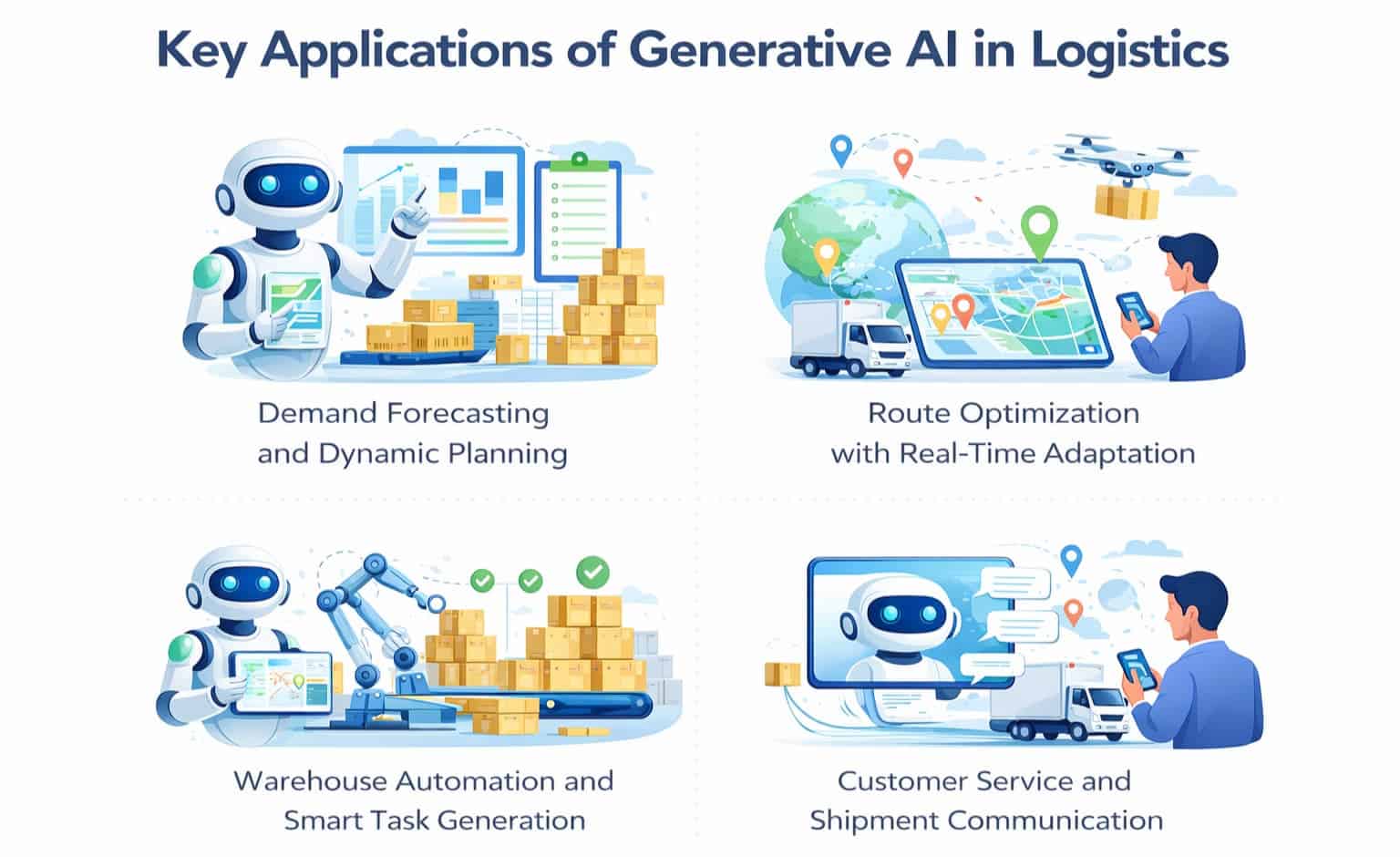
1) Demand Forecasting and Dynamic Planning
Traditional demand forecasting relies on historical trends, seasonal patterns, and basic predictive analytics. Generative AI can go further by simulating scenarios and generating alternative forecasts based on external factors such as consumer trends, marketing campaigns, competitor pricing, or regional events.
For example, a logistics company can ask a GenAI system:
- “How would increased online demand impact warehouse workload next week?”
- “Generate the best distribution plan if one hub becomes unavailable.”
GenAI can create multiple demand scenarios and propose action plans, allowing organizations to adjust inventory positioning and transportation schedules faster.
2) Route Optimization with Real-Time Adaptation
Route optimization has long been a logistics innovation focus. However, many optimization systems are constrained by limited rule sets. GenAI can enhance routing by combining optimization algorithms with natural language and real-time reasoning.
A generative AI assistant can:
- Suggest alternative routes based on traffic, weather, and delivery priorities
- Generate driver instructions and communication automatically
- Explain trade-offs between cost, speed, and carbon footprint
- Create contingency routing plans if conditions change mid-shift
This improves last-mile efficiency and reduces delays while maintaining customer satisfaction.
3) Warehouse Automation and Smart Task Generation
Warehouses are increasingly automated, but the human element remains critical. Generative AI can support warehouse teams by generating task instructions, optimizing picking strategies, and improving space utilization.
Use cases include:
- Generating optimized picking routes based on order priority and shelf location
- Summarizing daily operational performance and suggesting improvements
- Creating safety guidance based on incident logs
- Automatically generating training materials for new warehouse employees
GenAI also improves coordination between human workers and robotics systems by turning operational data into understandable workflows.
4) Customer Service and Shipment Communication
Logistics customer service teams handle constant requests: shipment tracking, delivery changes, returns, and delay explanations. Generative AI can reduce response time and improve consistency by acting as a multilingual support assistant.
It can:
- Generate personalized shipment updates and delay explanations
- Provide customers with proactive ETA updates
- Offer alternative delivery options automatically
- Summarize complex shipment history for support agents
This helps logistics providers deliver a better customer experience while reducing the workload on support teams.
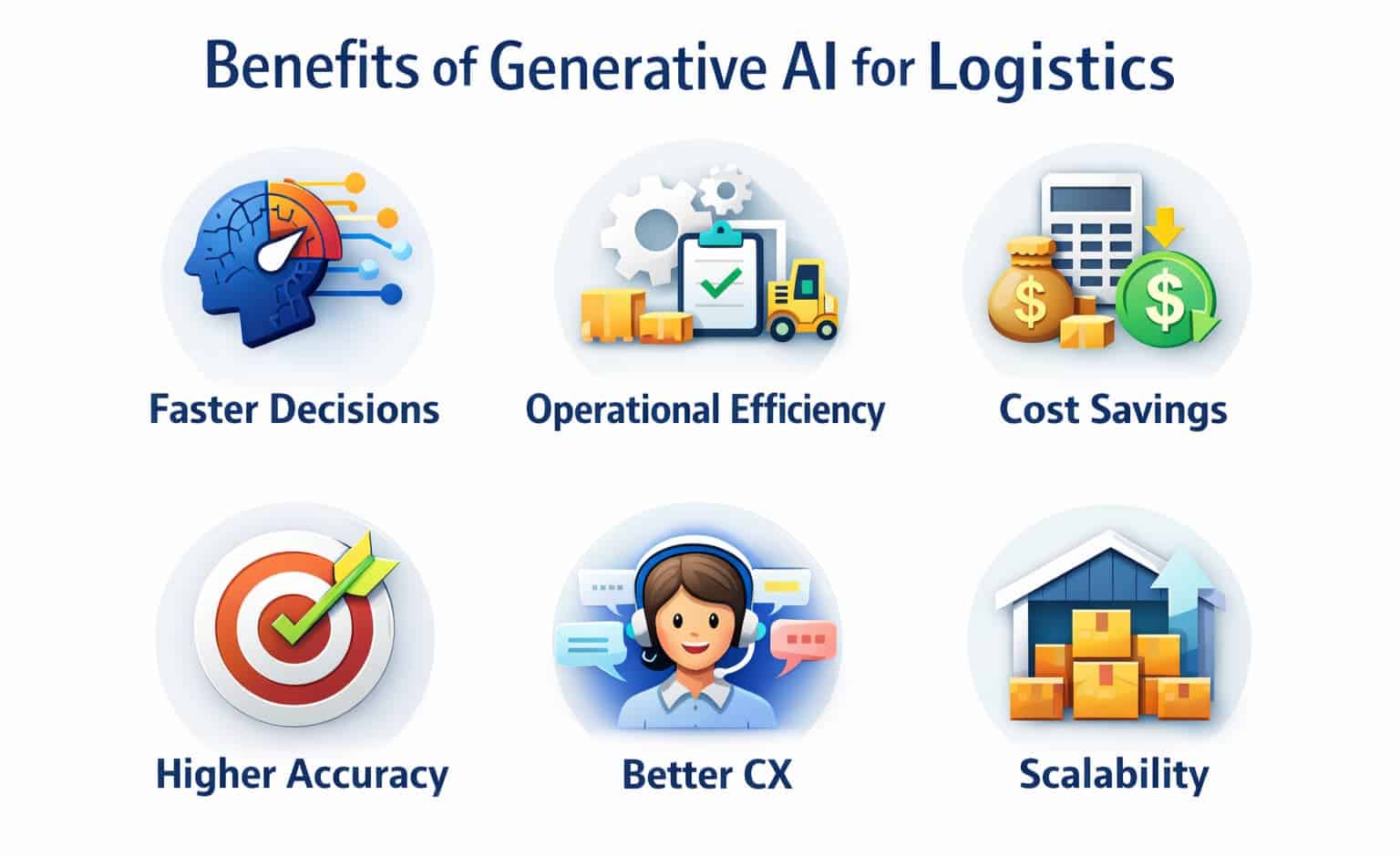
Benefits of Generative AI for Logistics Companies
When implemented properly, generative AI delivers measurable value:
- Faster decision-making: real-time recommendations reduce planning delays
- Operational efficiency: automation of routine communication and documentation
- Cost savings: improved routing, load planning, and utilization
- Higher accuracy: reduced human errors in documentation and forecasting
- Better customer experience: more personalized, proactive service
- Scalability: ability to support growth without proportional staffing increases
Challenges and Implementation Considerations
While GenAI brings strong benefits, logistics companies should plan carefully. Key challenges include:
- Data quality and integration: GenAI models rely on clean, consistent data from multiple systems
- Security and confidentiality: logistics data is sensitive and often shared across partners
- Model accuracy and control: decisions must remain explainable and auditable
- Change management: teams need training and clear policies for AI usage
- Regulatory compliance: especially in transportation safety, customs, and labor laws
A successful GenAI strategy typically starts with pilot projects, focusing on high-impact processes like customer service automation or document generation, then scaling into planning and optimization systems.
Implementing generative AI in logistics is not only about selecting the right model — it also requires integrating data sources, aligning AI outputs with real operational processes, and ensuring the solution remains secure and scalable. Teams with experience in logistics software development can be essential in bridging that gap.
Wrapping up
In conclusion, Generative AI is revolutionizing the logistics industry by enhancing decision-making, improving operational efficiency, and creating smarter, more resilient supply chains. As we move through 2026, companies that embrace these AI-driven innovations will be better positioned to adapt to changing demands, reduce costs, and deliver superior customer experiences. The future of logistics is not just about automation, but about intelligence that drives real-time adaptability and efficiency.