Implementing 360 Surround View Camera Systems in Autonomous Vehicles
The evolution of autonomous vehicle technology has witnessed remarkable advancements in recent years, with perception systems playing a pivotal role in enabling safe and reliable autonomous operation. As vehicles become increasingly sophisticated, the demand for comprehensive environmental awareness has driven the development of more advanced sensing technologies and processing capabilities.
Integrating multiple sensor modalities has become fundamental to achieving robust environmental perception in autonomous vehicles. Among these various sensing technologies, camera-based systems have emerged as a cornerstone of modern autonomous vehicle architecture, offering high-resolution visual data at relatively low cost.
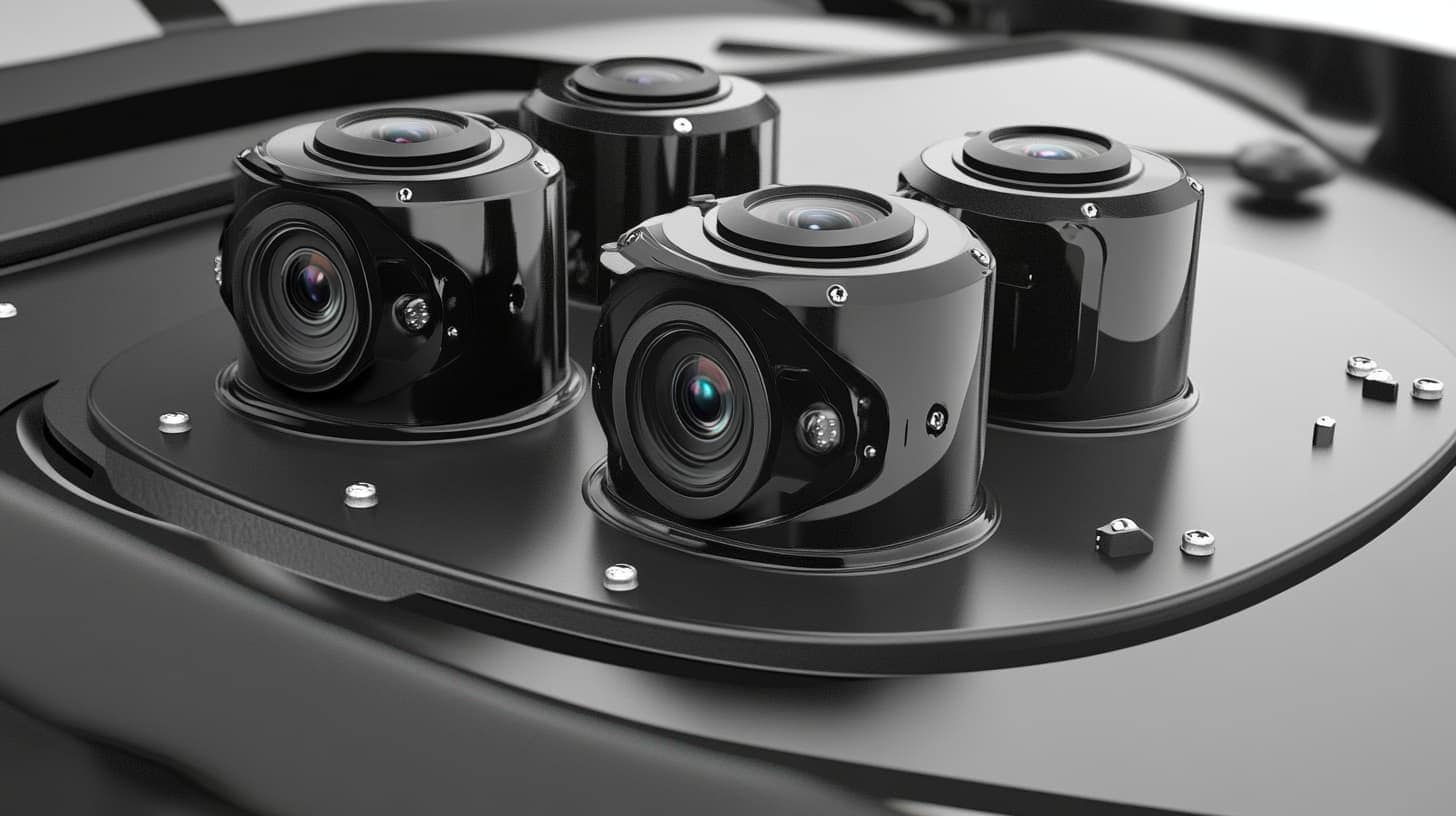
The 360 surround view camera system represents a significant leap forward in visual perception technology, providing autonomous vehicles with a complete panoramic view of their environment. This sophisticated system typically comprises multiple wide-angle cameras strategically mounted around the vehicle, working in concert to generate a seamless, bird’s-eye view of the surrounding area, while simultaneously providing detailed peripheral vision critical for navigation and safety.
System Architecture
The foundation of an effective surround view system lies in its carefully designed architecture, which encompasses both hardware and software components working in harmony. At the hardware level, the system typically employs four to six high-resolution cameras with wide-angle lenses, strategically positioned to eliminate blind spots and ensure complete coverage of the vehicle’s surroundings. These cameras must meet stringent requirements for image quality, frame rate, and synchronization to enable accurate real-time processing.
The data processing pipeline begins with raw image capture from multiple cameras, each operating at frame rates typically exceeding 30 frames per second. These image streams are processed through dedicated hardware units, often utilizing specialized image signal processors (ISPs) designed to handle high-bandwidth visual data. The processed images undergo various transformations and corrections before being combined into a unified view of the environment.
Central to the system’s operation is a powerful computing platform capable of handling multiple high-bandwidth video streams while performing complex image processing tasks in real-time. Modern implementations often utilize a combination of CPUs, GPUs, and dedicated vision processing units (VPUs) to achieve the necessary performance while maintaining power efficiency. The architecture must support ultra-low latency data paths and high-speed interfaces to ensure seamless operation of the entire system.
Image Processing and Computer Vision
The core functionality of a surround view system relies heavily on sophisticated image processing and computer vision algorithms. The initial stage involves camera calibration, a critical process that must account for both intrinsic parameters (such as focal length and lens distortion) and extrinsic parameters (relating to camera positions and orientations). This calibration process ensures accurate geometric relationships between multiple camera views and enables precise image stitching.
Image stitching algorithms form the heart of the system, transforming multiple camera feeds into a coherent, unified view. These algorithms must handle various challenges, including perspective differences, exposure variations, and moving objects. Advanced implementations employ real-time optimization techniques to maintain image quality while meeting strict performance requirements. The stitching process involves multiple stages, including feature detection, matching, homography estimation, and seamless blending.
Modern systems increasingly incorporate deep learning techniques to enhance their capabilities. Neural networks trained on vast datasets can improve image quality, detect objects, and even predict motion patterns. These AI-powered features complement traditional computer vision algorithms, creating a more robust and capable system. The integration of machine learning must be carefully balanced with computational resources and real-time requirements.
Integration with Autonomous Systems
The true power of a surround view system emerges when it is fully integrated into the autonomous vehicle’s broader perception framework. This integration requires careful consideration of sensor fusion techniques, synchronization mechanisms, and data flow architectures. The system must work seamlessly with other sensing modalities, particularly LiDAR and radar, to create a comprehensive understanding of the vehicle’s environment.
Sensor fusion algorithms combine data from multiple sources while accounting for the strengths and limitations of each sensor type. While cameras excel at providing rich visual information and detecting texture-based features, they may struggle in adverse lighting conditions or weather. Complementary sensors like LiDAR provide precise depth measurements but lack color and texture information. The fusion of these different data streams requires sophisticated algorithms that can handle varying update rates, different coordinate systems, and inherent sensor uncertainties.
The integration process extends beyond simple data fusion to include temporal alignment and spatial registration of sensor data. Modern autonomous vehicles employ precise timing systems to ensure that data from different sensors can be correctly associated and processed. This temporal synchronization is crucial for accurate motion estimation and prediction, particularly in dynamic environments where objects may be moving at varying speeds.
Real-world Implementation Challenges
Implementing a 360 surround view system in real-world conditions presents numerous technical challenges that must be carefully addressed. Environmental factors pose significant obstacles to reliable system operation. Varying lighting conditions, from direct sunlight to complete darkness, require sophisticated exposure control and HDR processing capabilities. Weather effects such as rain, snow, or fog can severely impact image quality and must be mitigated through both hardware and software solutions.
Performance optimization represents another critical challenge in practical implementations. The system must process multiple high-resolution video streams with minimal latency while maintaining image quality and accuracy. This requires careful optimization of the entire processing pipeline, from initial image capture to final view generation. Modern implementations leverage hardware acceleration through GPUs and dedicated vision processors, along with optimized algorithms that balance quality with computational efficiency.
System reliability and safety considerations are paramount in autonomous vehicle applications. The surround view system must incorporate robust error detection and handling mechanisms, along with redundancy features to ensure continued operation even if individual cameras or processing units fail. Regular self-diagnostics and calibration checks help maintain system accuracy over time, while sophisticated fault detection algorithms can identify and respond to various types of system malfunctions.
Testing and Validation
The development of a robust surround view system requires comprehensive testing and validation procedures. Testing must cover not only individual components but also system-level integration and performance under various operating conditions. Modern development approaches employ a combination of simulation-based testing and real-world validation to ensure system reliability.
Simulation environments allow developers to test the system under a wide range of scenarios, including edge cases that might be difficult or dangerous to reproduce in real-world testing. These virtual environments can simulate various lighting conditions, weather effects, and complex traffic scenarios, providing valuable data for system optimization and validation. However, simulation testing must be complemented with extensive real-world validation to ensure that the system performs as expected under actual operating conditions.
Performance metrics for surround view systems encompass various aspects, including image quality, processing latency, calibration accuracy, and system reliability. Objective measurements of these parameters help ensure that the system meets its design requirements and performs consistently over time. Regular evaluation of these metrics, along with continuous monitoring during operation, helps maintain system performance and identify potential issues before they become critical.
Future Developments
The field of surround view camera systems continues to evolve rapidly, driven by advances in both hardware and software technologies. Emerging sensor technologies promise higher resolution, better low-light performance, and improved dynamic range, enabling more robust operation across a wider range of environmental conditions. Novel sensor designs, such as event-based cameras, may complement traditional imaging sensors by providing better motion handling and reduced data bandwidth.
Artificial intelligence and machine learning technologies are expected to play an increasingly important role in next-generation systems. Advanced neural networks will enable more sophisticated object detection, tracking, and scene understanding capabilities. These AI-powered features will enhance the system’s ability to identify potential hazards, predict object trajectories, and make informed decisions about vehicle behavior. The integration of edge computing capabilities will allow more processing to be performed directly at the sensor level, reducing latency and improving system responsiveness.
Standardization efforts across the industry are working to establish common interfaces and protocols for surround view systems. These standards will facilitate interoperability between different vendors’ components and simplify system integration. Additionally, regulatory frameworks are evolving to address safety requirements and performance standards for camera-based perception systems in autonomous vehicles.
Conclusion
The implementation of 360 surround view camera systems represents a crucial advancement in autonomous vehicle technology, providing comprehensive environmental awareness essential for safe and reliable operation. Modern implementations successfully address the complex challenges of real-time environmental perception by carefully considering system architecture, sophisticated image processing algorithms, and robust integration with other vehicle systems.
As autonomous vehicle technology continues to mature, surround view systems will become increasingly sophisticated, incorporating advanced AI capabilities and improved hardware components. The ongoing development of industry standards and best practices will facilitate wider adoption and integration of these systems across different vehicle platforms and use cases.
Future research and development efforts should focus on improving system robustness in challenging environmental conditions, reducing computational requirements while maintaining performance, and enhancing integration with other vehicle systems. Additionally, continued work on standardization and safety validation will be crucial for widespread deployment in autonomous vehicles.